
Imagine clicking “Update” on your smartphone. How do you know a hacker didn’t intercept that download in transit and replace it with malware?
Behind the scenes, a silent mathematical guard is verifying that the software genuinely came from Apple or Google. It ensures that not a single byte has been altered. That guard is a digital signature.
Digital signatures underpin almost every secure interaction on the internet. They secure your text messages, verify website certificates, and validate blockchain transactions.
But the ground beneath these signatures is shifting. The math that has protected the internet for decades is about to face its ultimate test from quantum computers. Meanwhile, entirely new ways of signing data—using the laws of physics itself—are emerging from research labs.
Here is a practical breakdown of how digital signatures work, which ones you should use, and how to prepare your systems for the future.

What Is a Digital Signature?
Think of a digital signature like an unbreakable digital wax seal. It allows you to prove you wrote a message using a private key, while anyone else can verify it using your matching public key.
A proper digital signature gives you three guarantees:
- Authenticity: It proves exactly who created the message.
- Integrity: It guarantees the message wasn’t tampered with. (Change a single comma, and the seal breaks).
- Non-repudiation: The signer cannot credibly deny they wrote it.
Unlike a handwritten signature, a digital one is mathematically tied to the exact contents of the file.e a handwritten signature, a digital signature is mathematically bound to the exact contents of a message. Change a single byte, and the signature becomes invalid.
The Classics: RSA and ECDSA
For over forty years, the internet has relied on math problems that are incredibly hard for classical computers to solve.
RSA: The Speedy Verifier
RSA relies on a simple concept: multiplying two giant prime numbers together is easy, but factoring the result back into the original primes is nearly impossible.
To get 128-bit security today, you need a massive 3072-bit RSA key. However, RSA has a superpower: verification speed. Checking an RSA signature takes very little computing power. This makes it perfect for environments where you verify signatures millions of times a day, like website certificate validation.
If you use RSA today, make sure you are using the modern, secure variant called RSA-PSS.
ECDSA: The Bandwidth Saver
The Elliptic Curve Digital Signature Algorithm (ECDSA) offers the same security as RSA but with much smaller keys. A 256-bit ECDSA key equals that massive 3072-bit RSA key. Because of this, ECDSA is the go-to choice for bandwidth-constrained systems like IoT devices, TLS certificates, and legacy Bitcoin transactions.
The catch: ECDSA requires a fresh, random number (a nonce) every single time you sign something. If you accidentally reuse that number, hackers can steal your private key. This exact human error has caused real-world, multimillion-dollar crypto heists.
The Modern Favorites: EdDSA and Schnorr
To fix the dangers of human error in ECDSA, cryptographers built better tools.
EdDSA: The Safe Upgrade
EdDSA (specifically Ed25519) removes the need for random numbers entirely. It uses a deterministic process, meaning the same private key and message will always produce the exact same signature safely. It is fast, simple to code, and highly secure. You are using EdDSA if you use Signal, Tor, WireGuard, or modern SSH keys.
Schnorr: The Team Player
Schnorr signatures are becoming the foundation for collaborative systems. Their superpower is multisignatures. Multiple people can sign a single document together, but to the outside world, it looks exactly like one normal signature.
Bitcoin adopted Schnorr signatures in its Taproot upgrade, allowing complex, multi-user transactions to look identical to simple, private payments.
The Team Player: BLS Signatures
Sometimes, you don’t just want a few people to sign together—you want to mash thousands of signatures into one.
That is where BLS (Boneh–Lynn–Shacham) signatures shine. Using complex math called “pairings,” BLS lets you combine thousands of independent signatures into a single, tiny signature. The signers don’t even need to talk to each other to do it.
Real-world example: Ethereum’s proof-of-stake network uses BLS signatures. When tens of thousands of validators approve a block of transactions, BLS math squashes all their signatures into one, saving massive amounts of network bandwidth.
Preparing for the Quantum Era
Here is the problem: A sufficiently powerful quantum computer running Shor’s algorithm will not just weaken RSA and ECDSA—it will break them completely.
To stop this, the US National Institute of Standards and Technology (NIST) spent years racing to find new “Post-Quantum” signature families. In August 2024, they finalized their first two standards:
- ML-DSA (FIPS 204): Based on “lattice” math. This is expected to become the general-purpose replacement for RSA and ECDSA.
- SLH-DSA (FIPS 205): Based purely on hashing. Its security assumptions are the most conservative in the world, though the signatures are quite large.
A third standard, FN-DSA (FIPS 206), is currently working its way through the final draft and review process, with industry estimates pointing to a final standard in late 2026 or early 2027. Also lattice-based, FN-DSA is designed to offer incredibly compact signatures, making it great for systems where storage space and bandwidth are tightly constrained.
Note: The race isn’t over. Schemes like Rainbow once looked incredibly promising but were completely broken by researchers (Ward Beullens published a practical key-recovery attack on Rainbow in 2022). Others, like SIKE—a finalist for post-quantum key exchange—were broken by a shockingly simple classical attack just days after making it to the final round. This proves why long, aggressive public testing is vital before trusting new math.
Specialized Signatures for Complex Problems
Digital signatures don’t just prove “who signed this.” They can be customized for complex privacy and authorization needs:
- Privacy-Preserving (Blind, Ring, Group signatures): These hide who the signer is. They are used for anonymous voting, electronic cash, and anonymous credentials.
- Controlled Verification (Designated verifier, Undeniable signatures): These restrict who is allowed to verify a signature, protecting signers from blackmail or unauthorized exposure.
- Multi-Party Authorization (Threshold, Aggregate, Proxy signatures): These allow groups to jointly authorize operations (like accessing a corporate treasury) without exposing any individual’s private key.
- Mutable Signatures (Redactable, Forward-secure signatures): These allow a document to be edited or redacted later without breaking the original signature, which is incredibly useful for long-term data archival.
The Bleeding Edge: Quantum Signatures
Do not confuse Post-Quantum Cryptography with Quantum Cryptography.
Post-quantum algorithms (like ML-DSA) run on normal computers. They use new math to fight future quantum computers.
Quantum signatures are entirely different. Instead of math, they use the laws of quantum physics—specifically, the No-Cloning Theorem, which states you cannot perfectly copy an unknown quantum state.
In Quantum Digital Signatures (QDS), you don’t send a math equation; you send physical quantum states (like photons) to verifiers. If a hacker tries to intercept and forge the signature, the laws of physics guarantee they will be caught.
Today, QDS remains mostly locked in research labs because it requires specialized quantum communication infrastructure. But it promises a future where forgery is physically impossible, not just mathematically hard.
Which Signature Should You Choose?
There is no single “best” algorithm. The right choice depends entirely on what you are building:
- Need broad compatibility and fast verification? Use RSA-PSS.
- Building modern software or APIs? Use EdDSA (Ed25519).
- Building a system where multiple users sign together? Use Schnorr.
- Need to aggregate thousands of signatures into one? Use BLS.
- Future-proofing against quantum computers? Start planning your migration to ML-DSA.
- Need the most conservative post-quantum security? Use SLH-DSA.
- Need compact post-quantum signatures for tight storage? Plan for FN-DSA.
What You Need to Do Next
Digital signatures have evolved from simple document authentication into a massive, diverse toolkit. The shift to post-quantum cryptography is no longer a theoretical debate—it is an engineering challenge happening right now.
You cannot afford to wait until quantum computers arrive to upgrade your systems. Hackers are already harvesting encrypted data today to decrypt it later in “Store Now, Decrypt Later” attacks.
Here is your action plan:
- Audit your stack: Map out every place your software generates or verifies signatures (TLS, APIs, code signing, database backups).
- Drop the legacy: If you are still using DSA or basic ECDSA without deterministic nonces, migrate to EdDSA today.
- Build crypto agility: Ensure your systems are designed so you can swap out signature algorithms without rewriting your entire application.
- Start testing PQC: Download the NIST ML-DSA libraries and run them in your test environments.
The quantum era is coming. Make sure your digital seals are ready for it.
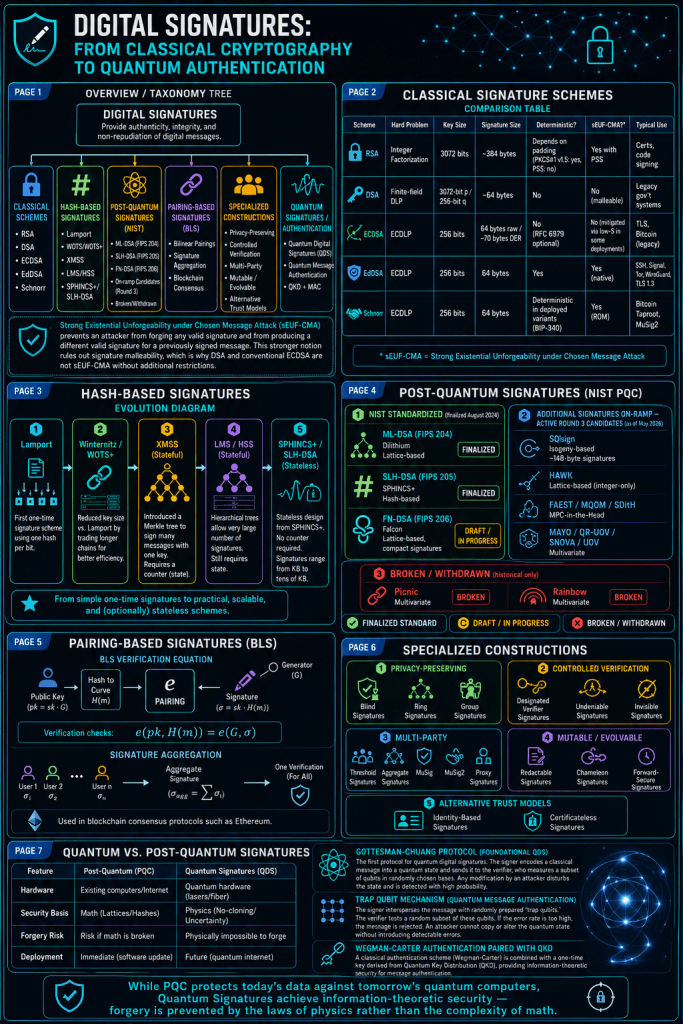
The infographic below summarizes the evolution of digital signature schemes—from classical cryptography to post-quantum and quantum authentication—and serves as a quick reference to the major signature families discussed throughout this article.
References
- National Institute of Standards and Technology (NIST). FIPS 186-5: Digital Signature Standard (DSS), 2023.
- National Institute of Standards and Technology (NIST). FIPS 204: Module-Lattice-Based Digital Signature Standard (ML-DSA), August 2024.
- National Institute of Standards and Technology (NIST). FIPS 205: Stateless Hash-Based Digital Signature Standard (SLH-DSA), August 2024.
- National Institute of Standards and Technology (NIST). FIPS 206: FN-DSA — Digital Signature Standard Based on Falcon, 2024/Current publication status.
- Internet Engineering Task Force. RFC 8032 — Edwards-Curve Digital Signature Algorithm (EdDSA), January 2017.
- Internet Engineering Task Force. RFC 6979 — Deterministic Usage of DSA and ECDSA, August 2013.
- Internet Engineering Task Force. RFC 8017 — PKCS #1: RSA Cryptography Specifications Version 2.2, November 2016.
- Bitcoin Improvement Proposals. BIP-340 — Schnorr Signatures for secp256k1.
- Serious Cryptography. Jean-Philippe Aumasson. No Starch Press, 2024.
- Cryptography: A Very Short Introduction. Sean Murphy and Rachel Player. Oxford University Press.
- Introduction to Modern Cryptography. Jonathan Katz and Yehuda Lindell.
- Handbook of Applied Cryptography. Alfred Menezes, Paul van Oorschot, and Scott Vanstone.
- Boneh–Lynn–Shacham signature scheme. “Short Signatures from the Weil Pairing.” 2001.
- MuSig2>. Simple Two-Round Schnorr Multi-Signatures.
- SPHINCS+ documentation.
- CRYSTALS-Dilithium documentation.
- Falcon documentation.
- Gottesman–Chuang quantum digital signatures.
- Wegman–Carter authentication.